
Pilates Movement Monday: Reformer Single-Leg Footwork – Under the Bar or Tabletop?

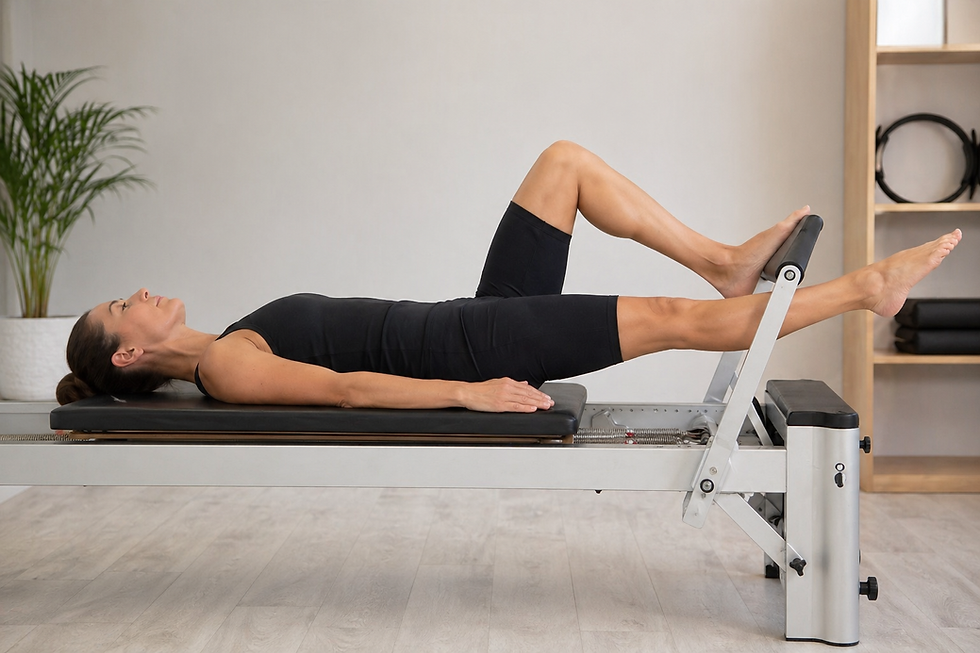
This week I want to look at a small variation on the Pilates reformer that can make a very big difference, especially when we start thinking about posture and muscle balance rather than just getting through the movement.
We’re looking specifically at single-leg footwork on the reformer. The question is simple. Do we bring the non-working leg into tabletop, or do we keep it extended under the bar?
Both are valid reformer variations. Both have a place. But they are not the same.
When I see a client standing with a pronounced anterior pelvic tilt, that classic hyperlordotic posture, I’m already thinking about what might be driving it. More often than not, we’re looking at tight hip flexors, particularly the psoas, doing far more work than they need to.
Now here’s where the choice of position on the reformer matters.
If we bring the leg into tabletop, we are shortening the hip flexors. On the reformer, that position can make it very easy for the psoas to take over. The leg feels supported, the work becomes familiar, and quite often the centre steps back instead of stepping in.
So although the movement looks clean, we may just be reinforcing the pattern that’s already dominant. This is why I often prefer the variation on the reformer where the leg stays under the bar. By extending the leg away under the footbar, we are lengthening through the hip flexors rather than shortening them. The client has to organise the centre to support the weight of the leg in a more open position on the reformer carriage. There is less opportunity to grip or overuse the front of the hip.
You’ll often see a clearer connection into the centre, a better sense of length through the body, and less tension around the pelvis when working this way on the reformer.
It also encourages the idea of reaching rather than holding, which is something many clients need. That said, tabletop on the reformer is not wrong. In fact, it can be exactly what some clients need.
If someone lacks strength in the hip flexors or struggles to control the leg in space, bringing the leg into tabletop on the reformer can help them shorten and strengthen in a supported way. It gives them a place to find control before asking for length.
So this is not about right or wrong. It’s about choice within the reformer repertoire.
As teachers, we have to look at the body in front of us. Look at how they stand. Look at how they move. Ask yourself what is overworking and what is underworking.
Then choose the variation on the reformer that helps restore balance, not just complete the exercise.
Because the goal is never just to move the carriage.
It’s to change the way the body organises itself.


Comments