
Pilates Movement Monday: Shoulder Bridge on the Reformer
- Michael King

- Feb 16
- 3 min read
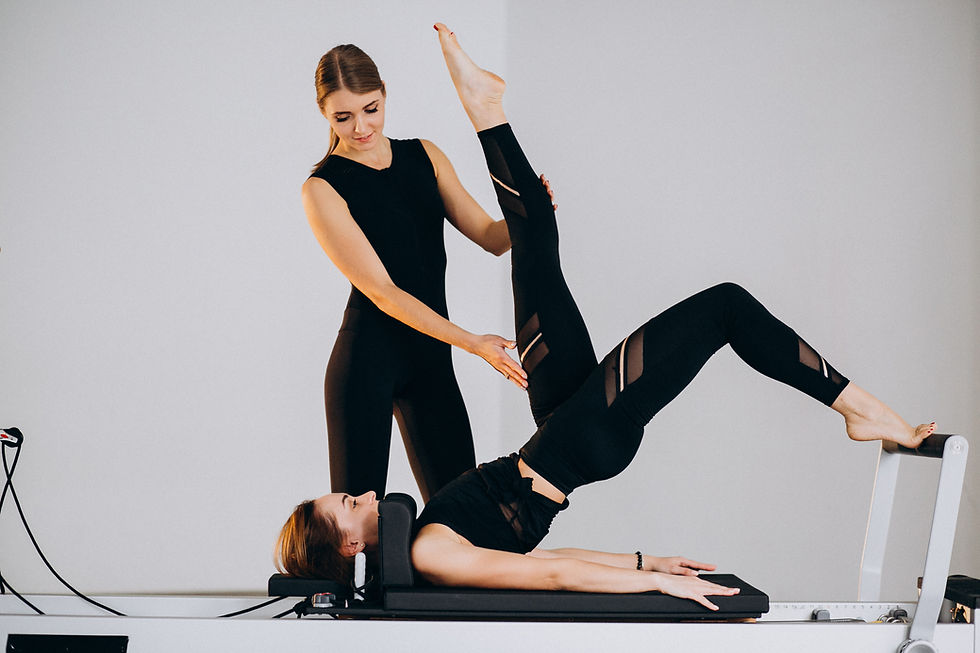
Today I want to spend a bit more time on the Pilates Shoulder Bridge on the Reformer, because although it looks like a simple strength exercise, it is one of those movements that quietly reveals everything about how someone is using their body. I often say that once you lift one leg, the truth appears. The pelvis will either remain organised and steady, or it will rotate, drop, or grip. There is no hiding in this exercise, and that is exactly why I value it so much in a session.
When I teach the Shoulder Bridge, I do not rush into the single leg version. I want to see a clear understanding of pelvic placement first. I want the client to articulate the spine with control, press evenly through the footbar, and feel the connection through the back of the hips rather than pushing from the knee. The supporting foot should feel grounded through the heel, with the shin vertical, and the pelvis lifting because the hip is extending, not because the ribs are flaring forward. If those basics are not in place, adding a lifted leg simply exaggerates the compensation.
Once we move into the single leg variation, the demand changes immediately. The base of support narrows, and the body has to organise itself under asymmetrical load. The gluteus maximus on the supporting side needs to work strongly, the hamstrings assist without dominating, and the deep abdominals stabilise the pelvis so it does not twist or hike. I am always watching the front of the pelvis. If one side drops or rotates when the leg lifts, that tells me the stabilisers are not yet coordinating effectively. That is not a failure. It is information, and it guides how I progress the programme.
Breath is another key element here. I prefer a gentle breath. If I can hear someone breathing loudly, they are often overworking through the upper body. I cue them to keep the ribcage soft and allow the breath to support the movement rather than overpower it. The carriage should move smoothly if we add extension and flexion through the hips. If it jerks, the force is likely coming from the knee or ankle rather than initiating at the hip joint. I am looking for control, not drama.
One common issue I see is hamstring cramping. This usually happens when the gluteals are not fully engaging or when the client is gripping to hold height instead of lengthening through the front of the hips. Another common pattern is pushing the head back into the headrest, creating unnecessary tension in the neck. Sometimes I lower the headrest for stronger clients, which increases the demand on spinal articulation and thoracic control, but only when they are ready. The goal is always integration, not strain.
I use the Shoulder Bridge as a progression in an intermediate session. It builds strength through the posterior chain, supports hip stability, and contributes to better gait and posture. More importantly, it teaches control under load. When the session finishes, I always bring the client back to standing. I want them to feel that connection from heel to pelvis, to sense how the work on the Reformer translates into upright alignment. The exercise is not about how high the leg lifts or how impressive it looks. It is about whether the pelvis remains steady and the movement remains organised. That is what I am interested in, and that is what I teach.


Comments