
Pilates Thoughtful Tuesday: Are We Collecting Experiences or Enjoying Them?

I recently found myself thinking about how differently we experience life today compared to even ten or fifteen years ago. We have always taken photographs. Family holidays were documented with cameras, special occasions were captured, and we all enjoyed looking back through albums of memories. The difference was that every photograph cost money, film was limited, and most importantly, we spent far more time experiencing the event than recording it.
Today almost every one of us carries a camera in our pocket. We can take hundreds of photographs in a single day without giving it a second thought. We can record videos, livestream events, share updates instantly, and let the world know exactly where we are and what we are doing. The technology is remarkable, but it does raise an interesting question.
Are we collecting experiences or actually enjoying them?
You only have to visit a concert, a tourist attraction, or even a beautiful sunset to see dozens of people watching it through the screen of their phone rather than with their own eyes. Sometimes it feels as though the proof that we were somewhere has become more important than actually being there. Instead of standing quietly and appreciating the moment, we are thinking about the angle, the lighting, the video, or what caption we might use when we post it online later.
I see the same thing happening at fitness events and Pilates conventions. During workshops and classes, there are often people recording large sections of the session. While I completely understand the desire to remember ideas and techniques, there are moments when participants spend so much time filming that they are no longer fully participating. They are watching the class through their phone instead of through their own experience. Ironically, they may leave with a perfect video recording but have absorbed less of what was actually being taught.
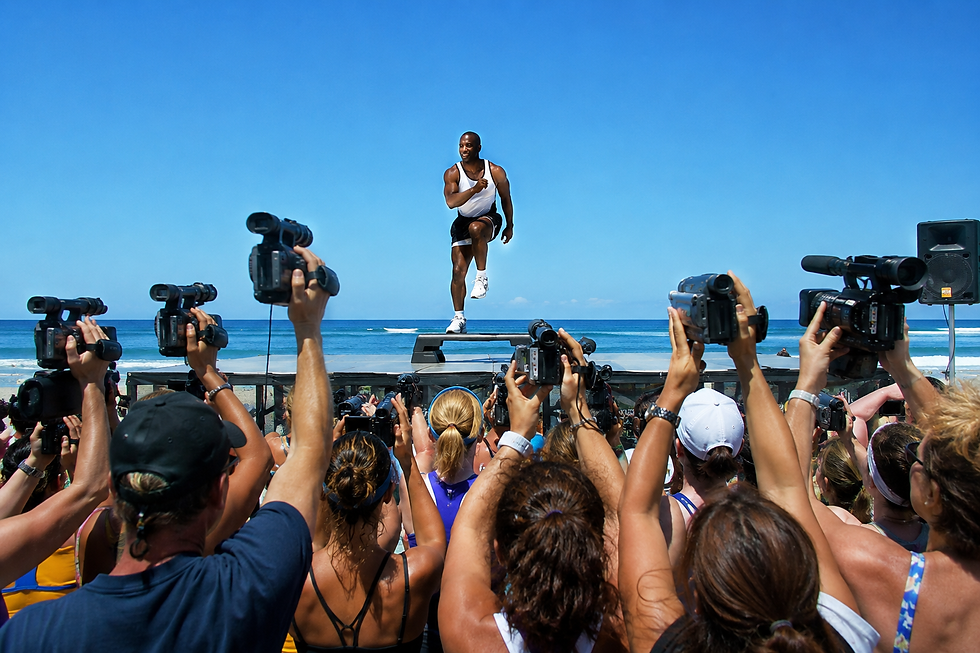
One of my favourite examples of this happened many years ago at a convention in Italy. A good friend of mine, Carl Powell, was teaching a step class on a large stage. As he looked out across the audience, he noticed something unusual. Instead of participating, a large number of people were standing at the front with cameras held high above their heads, filming the entire session. Very few were actually moving.
Carl stopped the music and politely explained that the purpose of the session was to experience the class, not simply record it. He encouraged everyone to put their cameras down and join in. The audience agreed, the music started again, and within moments many of the cameras were back in the air. Carl simply stood there laughing. It was one of the funniest and most revealing moments I have ever seen at a fitness convention. People had travelled across countries to attend a live experience, yet many were choosing to watch it through a screen rather than participate in it.
This idea is not new. In the Pilates world, Ron Fletcher was well known for discouraging students from taking notes during training sessions. His philosophy was simple. He believed movement had to be learned through the body first. You had to feel it, experience it, and embody it before trying to analyse or write about it. From a traditional movement education perspective, true learning came from participation, not documentation.
As teachers, we know that learning movement is not simply an intellectual process. It is sensory. It is about feeling, doing, experiencing, and sometimes making mistakes. A video can remind us of an exercise, but it cannot replace the physical sensation of performing it, feeling the breath, understanding the rhythm, and connecting with the movement. Some of the most valuable learning happens when we are completely immersed in the experience rather than documenting it.
Even in regular classes, there can be a temptation to photograph every achievement, every certificate, every workshop attended. There is nothing wrong with celebrating success or sharing experiences. In fact, photographs can be wonderful reminders of special times and the people we met along the way. The question is whether the act of recording sometimes distracts us from fully participating.
The brain forms memories through attention and emotional engagement. When we are fully present, we often remember experiences more vividly. When our attention is divided between living the moment and documenting it, perhaps we lose something along the way. We may end up with hundreds of images and videos but fewer genuine memories attached to them.
I often think about travel. Some of my favourite memories are not linked to photographs at all. They are connected to conversations, smells, sounds, laughter, and feelings. The first morning coffee in a new city. The feeling of arriving home after weeks away. Watching the sea at sunrise. Seeing Bella and Coco waiting at the door after being away. None of these moments require a camera to be meaningful.
Perhaps the challenge is not to stop taking photographs or videos but to become more selective. Capture the moment if you wish, then put the phone away. Take a photograph, record a short clip, and then return your full attention to the experience itself.
As Pilates teachers, we often encourage clients to be present in their movement, to notice how their body feels, how they are breathing, and how they are connecting to the exercise. Maybe the same principle applies to life itself. Sometimes the most valuable moments are the ones that never make it onto social media, never get uploaded, and are simply experienced for what they are.
This week, take a moment to consider whether you are collecting experiences or truly enjoying them. The memory you carry with you may prove far more valuable than the video sitting unnoticed in your phone's camera roll, joining the thousands of other clips that seemed important at the time and now quietly gather digital dust.
Technology has given us the ability to record almost everything. The real skill may be knowing when to put the camera down and simply enjoy the moment. After all, life is meant to be lived, not just archived.


Comments